Journaling Crypto Trades: What Is Different
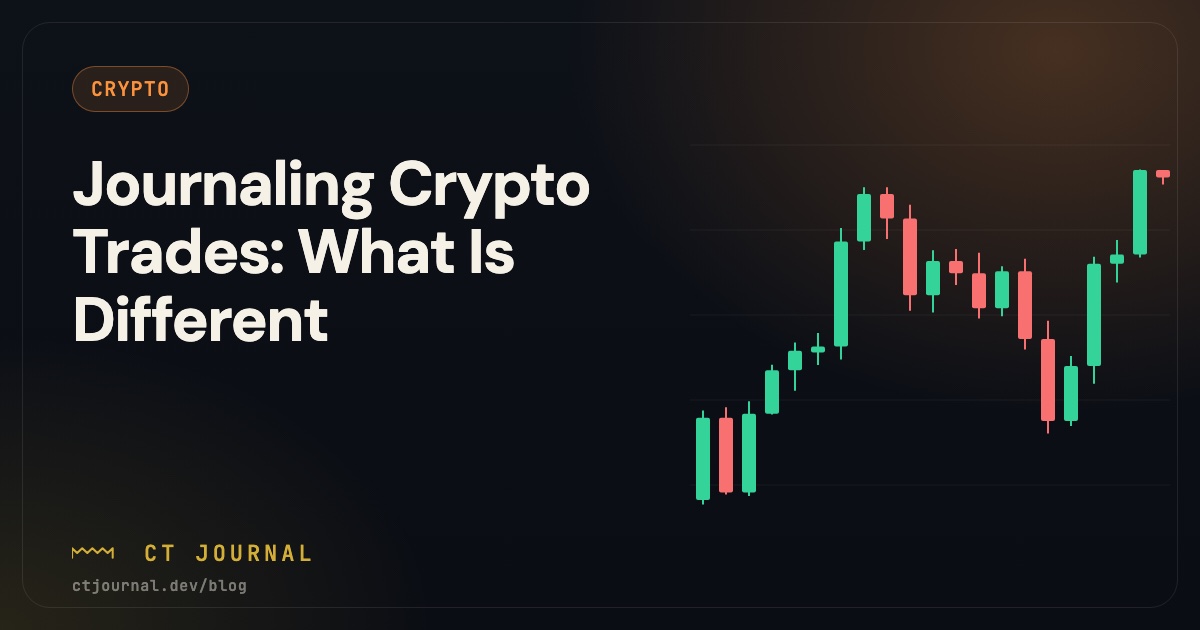
The basics of journaling are the same for every market: record the setup, the plan, the result and what you were thinking. Crypto, though, has features that make a standard template incomplete. If you trade crypto, a few extra fields will make your journal far more useful.
What makes crypto different
- The market never closes. There is no daily open or close, no weekend gap in the same sense, and sessions are less defined. Trades can happen at any hour, including when you are tired.
- Many venues. The same asset trades on several exchanges, and your records may be scattered across them.
- Spot and derivatives. You may hold coins outright, trade perpetual futures with leverage, or both.
- Funding and fees. Perpetual contracts charge or pay funding at regular intervals, and fees vary between maker and taker orders.
- High volatility. Moves of several percent in a day are routine, which affects stop placement and sizing.
- Liquidation. Leveraged positions can be closed automatically if the margin runs out.
Extra fields worth recording
On top of the standard journal fields, add:
- Exchange or account. So you can compare venues and reconcile balances.
- Spot or perpetual. Their risk and costs differ.
- Leverage used and margin mode. And the liquidation price, so you can check your stop sits well before it.
- Order type. Maker or taker, because it changes the fee.
- Fees paid and funding paid or received. Both can be larger than you expect on held positions.
- Time opened. Round-the-clock trading makes your own best and worst hours especially interesting. Sort results by hour and you may find a late-night pattern you did not know about.
Size by the stop, not by the leverage
Leverage is not your risk. Your risk is the distance to your stop times your position size. A high-leverage position with a close stop can be less risky than a low-leverage one with a wide stop. Work out the size from your risk percentage first, then check the margin it needs. Our position sizing guide has the formula, and for instruments priced per unit it is simple: risk amount divided by stop distance.
Make sure your stop is hit before the liquidation price, with room to spare. A liquidation is a worse exit than a stop, because the exchange sets the terms.
Watch the hidden costs
- Funding accumulates on perpetuals you hold for days. Record it, because it can turn a small winner into a loser.
- Fees on frequent small trades can be a large share of profit. See our costs guide.
- Withdrawal and network fees matter if you move funds between venues.
Keep clean records
Crypto trades often come from several exchanges, so records get messy. A few habits help:
- Use one journal for all venues, with the exchange recorded on each trade.
- Export or sync your history regularly instead of retyping it.
- Keep a note of transfers between accounts, so balances reconcile.
- Save the records of closed trades, because many people need them when they report gains. Tax rules differ by country and change, so check with a qualified professional. This article does not give tax advice.
Reduce the manual work
CT Journal can sync trades automatically from Bybit and import files from other sources, so the numbers are filled in and you add the reasoning, the emotion and a screenshot. You can then look at results by time of day, by instrument and by setup.
Be honest about the schedule
Because the market is always open, it is easy to trade all the time. Set trading hours like you would for forex, and decide when you will be away from the screen. A rested trader with a defined window usually does better than one who checks the chart at every hour.
Crypto markets are volatile and leveraged trading can lose more than you expect. Trading involves risk of loss.